Blog
Outdoor sauna size guide: choosing the right dimensions for your garden


Choosing an outdoor sauna is as much about proportion as it is about performance. Size affects how the sauna heats, how it feels to use, and how well it integrates into your garden over time. Too small, and the space feels restrictive and overheats unevenly. Too large, and the sauna becomes inefficient, slow to heat and difficult to place.
At True North, we design outdoor saunas to balance thermal performance, usability and architectural presence. Understanding how dimensions influence experience and efficiency helps ensure your sauna works properly from the first session and continues to perform for years.
Why sauna size matters more than you think
Sauna size is not simply about how many people it seats. The internal volume determines how air circulates, how evenly heat is distributed and how quickly the sauna reaches operating temperature. These factors directly affect recovery, comfort and consistency.
A well-sized sauna creates a dense, even heat that surrounds the body without extreme temperature gradients. When dimensions are poorly matched to the heater and layout, heat stratifies sharply, leaving feet cold and upper benches uncomfortably hot. Size, layout and heating capacity must work together.
Understanding internal vs external dimensions
When evaluating garden space, it is important to distinguish between internal and external dimensions. External dimensions determine planning, access and visual impact, while internal dimensions determine how the sauna performs and feels inside.
A compact external footprint can still deliver a spacious internal experience if wall thickness, insulation and layout are properly engineered. Conversely, a large external structure with inefficient insulation can feel underpowered and slow to heat. Always prioritise internal usable space and thermal design over headline exterior measurements.
How many people will use the sauna at once
Most private outdoor saunas are used by one to three people at a time, even when designed to seat more. This is important when choosing size. A sauna built for six people but used by two most of the time wastes energy and reduces heat density.
For individual or couple use, a compact two to three person sauna delivers faster heat-up times and a more intense, controlled environment. For families or social use, a four to six person layout allows flexibility while still maintaining performance, provided the heater is correctly specified.
Choosing capacity based on realistic use, not occasional scenarios, leads to better long-term satisfaction.
Bench height and vertical space
Vertical height plays a critical role in sauna performance. Heat rises, so bench placement relative to the heater and ceiling determines comfort and effectiveness. A sauna with insufficient height forces bathers into cooler air layers, reducing physiological benefit.
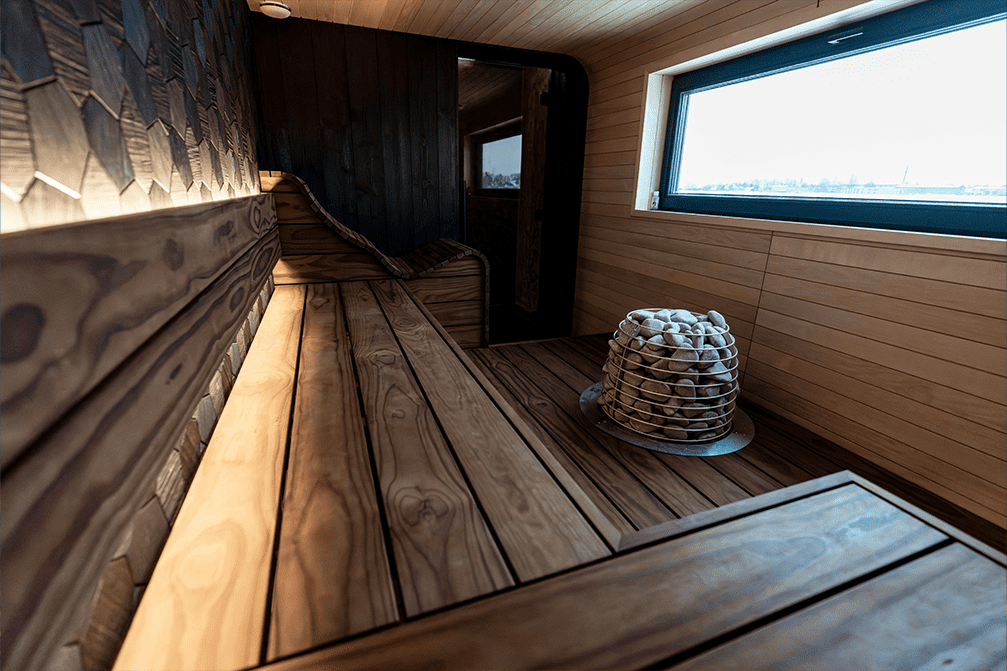
Properly designed outdoor saunas position the main sitting bench high enough to remain within the hottest air zone, while still allowing safe head clearance. This requires adequate internal height and careful proportioning. Simply increasing floor area without addressing vertical dimensions does not improve performance.
Garden space and placement considerations
Your garden dictates more than just maximum footprint. Access routes, ground preparation, boundary setbacks and sightlines all influence viable sauna size. A sauna should sit comfortably within its surroundings rather than dominate or feel compromised.
It is also worth considering how the sauna will be used year-round. Space for cooling off, moving around the structure and accessing doors safely in wet or icy conditions should be factored into overall planning. A slightly smaller sauna, placed well, often performs better than a larger one forced into an awkward position.
Efficiency, heat-up time and energy use
Larger saunas require more energy and take longer to reach operating temperature. This is not inherently negative, but it must align with how often and how quickly you plan to use the sauna.
For frequent, spontaneous use, a compact sauna that heats efficiently is usually preferable. For longer, planned sessions with multiple users, a larger volume can work well if properly insulated and paired with a suitable heater.
True North saunas are engineered so that size, insulation and heating capacity are matched precisely, ensuring predictable heat-up times and stable operating temperatures regardless of scale.
Designing for longevity, not just fit
A sauna should be sized not only for current needs but also for how your lifestyle may change. However, oversizing in anticipation of rare scenarios often compromises everyday performance.
The best approach is to choose dimensions that suit regular use, with enough flexibility to accommodate guests without sacrificing heat quality. Durability, insulation quality and thermal stability matter more than maximising floor space.
Why True North takes a different approach to sauna size
True North designs outdoor saunas as complete systems. Dimensions, insulation, timber selection and heater specification are all considered together. This ensures that every sauna, regardless of size, delivers even heat distribution, efficient energy use and long-term reliability in British weather.
By focusing on proportion rather than excess, our saunas integrate naturally into gardens while maintaining the performance standards required for recovery and resilience.
Choosing the right outdoor sauna size is about more than fitting it into your garden. It determines how the sauna heats, how comfortable it feels and how consistently it performs over time. The right dimensions balance internal volume, bench height, insulation and heater capacity to create a space that works with the body, not against it.
With careful planning and performance-led design, an outdoor sauna becomes a lasting part of your environment rather than a compromise. True North saunas are built to deliver that balance, ensuring every session is efficient, comfortable and effective.